> For the complete documentation index, see [llms.txt](https://docs.creativeconners.com/docs/llms.txt). Markdown versions of documentation pages are available by appending `.md` to page URLs; this page is available as [Markdown](https://docs.creativeconners.com/docs/spikemark/position-scale/limits.md).
# Limits
Limit are important. We talk about limits in two ways: [Hard Limits](/docs/spikemark/position-scale/limits/setting-hard-limits.md) and [Soft Limits](/docs/spikemark/position-scale/limits/setting-soft-limits.md)
## [Hard Limits](/docs/spikemark/position-scale/limits/setting-hard-limits.md)
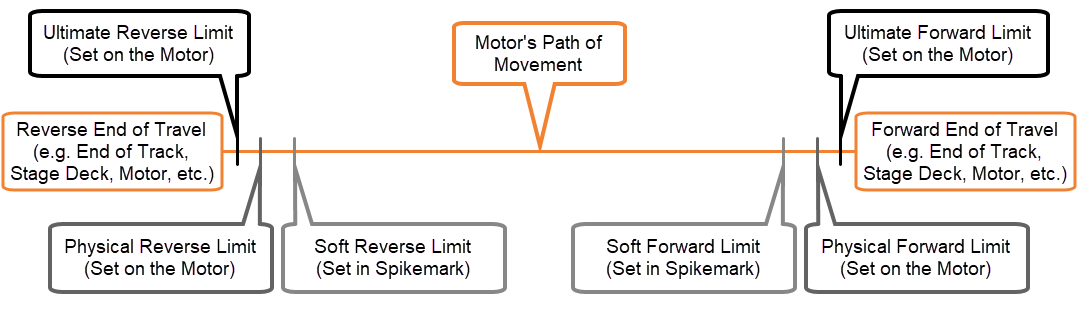
Physical limits that trigger a stopping response at the Stagehand and prevent the motor from moving. The hard limits should not be used to stop motion when running regular cues.
There are typically two sets of Hard Limits:
1. Initial Limits - set to constrain the travel during the show
2. Ultimate Limits - set at the furthest possible extents of travel to prevent hitting anything else.
## [Soft Limits](/docs/spikemark/position-scale/limits/setting-soft-limits.md)
Software(Soft) limits are set at the farthest extent of unit travel for cued motion. If you don’t have a specific location for these and pace and travel allows, we recommend setting the soft limits at least several inches inside your hard limits.
{% hint style="danger" %}
Soft Limits only prevent you from writing cues beyond this value, you still can [jog](/docs/spikemark/quickstart/jogging.md) your machines beyond this value.
{% endhint %}
When setting limits, use this graphic as a guide to where you should set each limit:
## Limit Indicator in Spikemark
The Triangles in the Axis Info Section shows the status of your limits
* Green - Limit Cleared
* Yellow - Exceeded Soft Limit
* Red - Exceeded Hard Limit
If you Override on a Stagehand Pro 5 or Stagehand Apprentice 2 or more recent, you will see a readout of Limit Overrides in the same area.
---
# Agent Instructions
This documentation is published with GitBook. GitBook is the documentation platform designed so that both humans and AI agents can read, navigate, and reason over technical content effectively. Learn more at gitbook.com.
## Querying This Documentation
If you need additional information that is not directly available in this page, you can query the documentation by asking a question.
Perform an HTTP GET request on the following URL with the `ask` and `goal` query parameters:
```
GET https://docs.creativeconners.com/docs/spikemark/position-scale/limits.md?ask=&goal=
```
`ask` is the immediate question: it should be specific, self-contained, and written in natural language.
`goal` is what the user is ultimately trying to achieve, the reason they need the answer. Sharing it helps GitBook give you a better, more relevant answer. A goal is most helpful when it describes the outcome the user wants rather than restating the question. For example, with `ask=how do I create an API token`, a goal like `automate deployments from our CI pipeline` lets GitBook tailor the answer to that use case.
The response will contain a direct answer to the question and relevant excerpts and sources from the documentation.
Use this mechanism when the answer is not explicitly present in the current page, you need clarification or additional context, or you want to retrieve related documentation sections.

